

Folding Japanese terroir into a French course
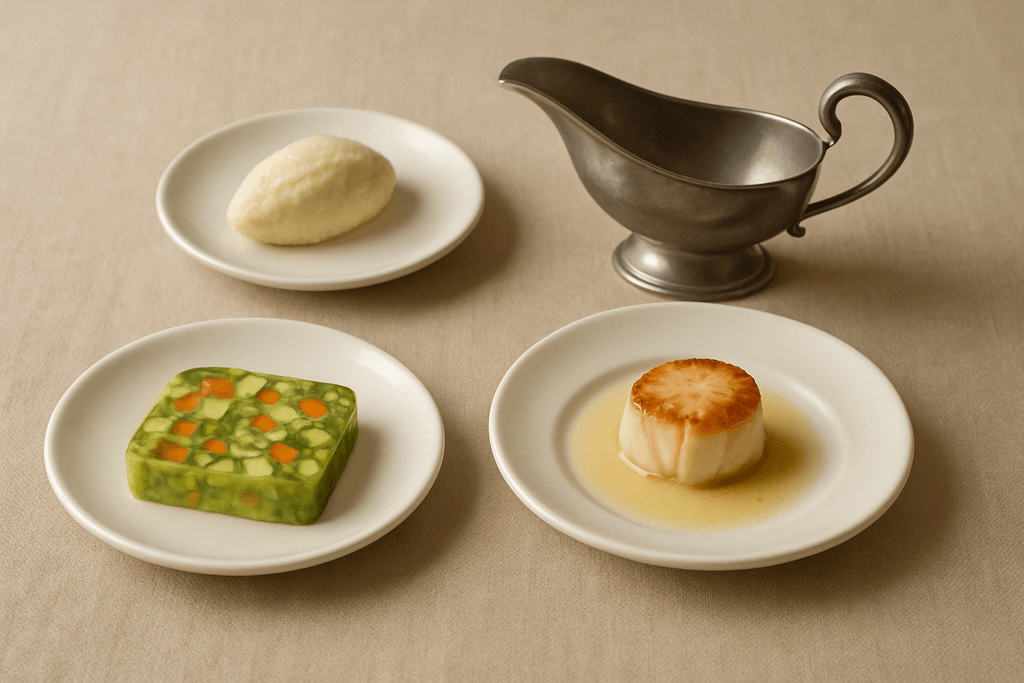
French cuisine is a culture of sauces and herbs. The layered sauces composed from fond de veau. The aromatic columns guided by a bouquet garni. The fine handwork of estragon and cerfeuil at the finish. These are the foundations of classical French cuisine, beginning with Auguste Escoffier's Le Guide Culinaire, and they continue, unbroken, in the innovations of contemporary kitchens.
What happens when a Japanese herb — one that carries the terroir of a particular place — is folded into this mature culinary system? Below, we share the pairing hypotheses and the working sketches that Sun&R.Lab is, today, beginning to discuss with chefs and sommeliers. Everything here sits in the Discovery phase. It is offered as a scenario to be polished, back and forth, in conversation with the partners who would build with us.
The five axes of pairing — the design premise for matching non-alcoholic to French cuisine
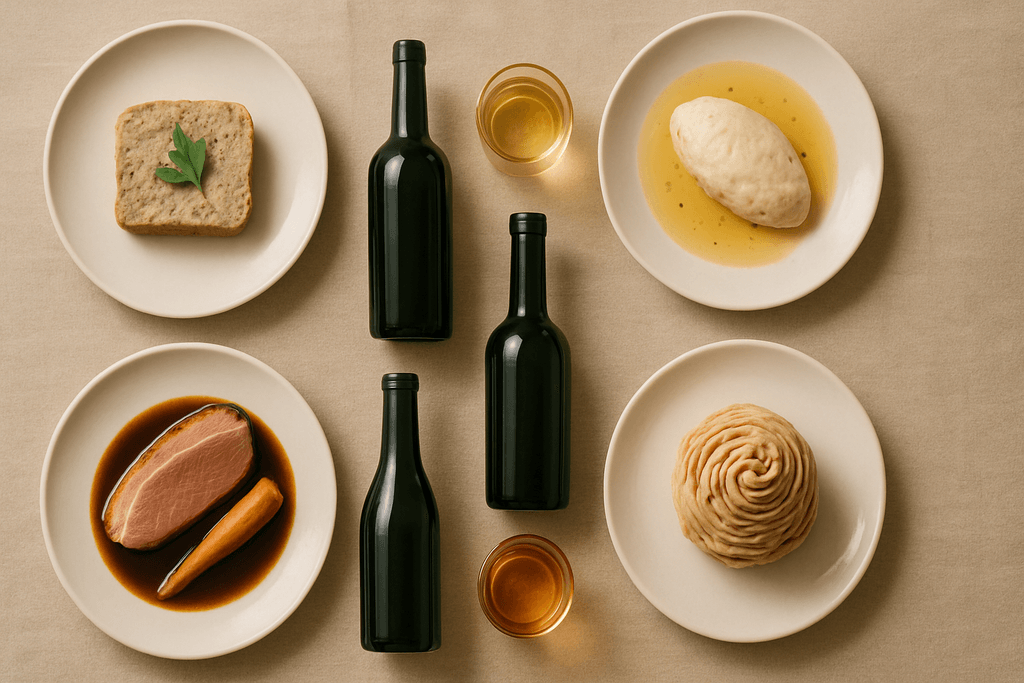
The pairing curriculum of the Association de la Sommellerie Internationale (ASI) names five primary axes for evaluating the meeting of food and drink: acidity, sweetness, bitterness, umami, aroma. Adding temperature and texture brings the count to seven — the world-standard frame for pairing design.
For French cuisine, the dish-side axes organise as follows.
- Acidity — foregrounded in starters and fish courses dressed in vinaigrette or finished with lemon.
- Sweetness — held quietly underneath, through mirepoix and the reduced fonds of slow-cooked sauces.
- Bitterness — concealed in a leaf of chicory, endive, or the green of a side salad.
- Umami — layered through fond, beurre monté, and aged cheeses.
- Aroma — blossoming via bouquet garni and the fines herbes added at the close.
- Temperature — composed across the entire course as a rise and fall of cold and warm.
- Texture — set in dialogue: purée, sauté, confit, grillé.
The design philosophy of French pairing, in non-alcoholic terms, is to compose materials on the drink side that answer to these seven axes.
The story of an evening — four glasses for four courses
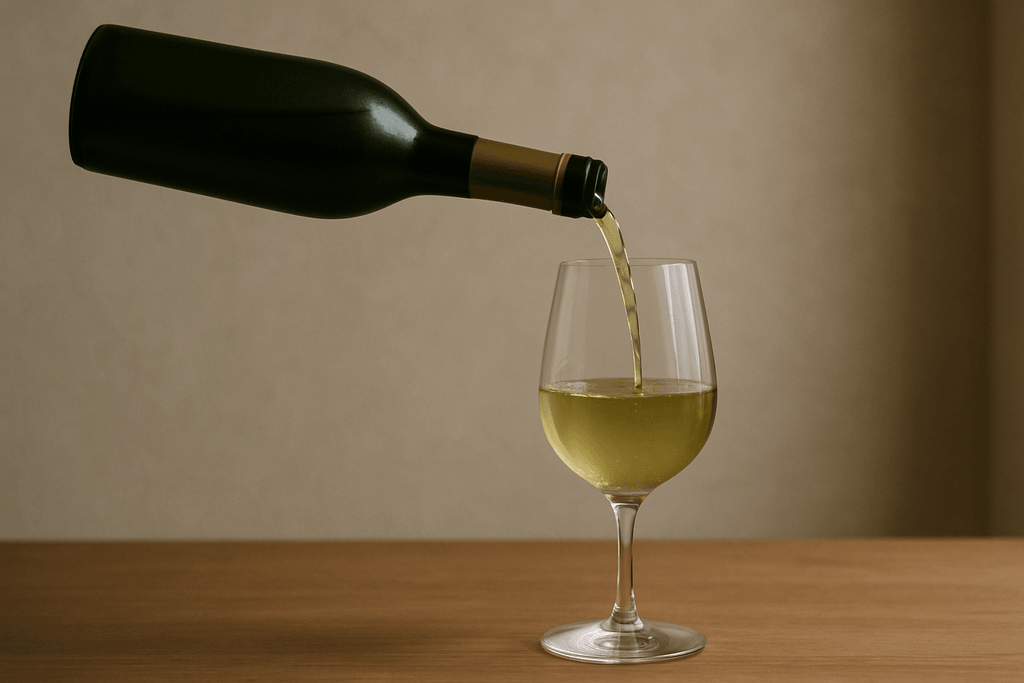
A specific scenario, drawn as a sketch. A four-course dinner imagined at a Michelin-starred French restaurant, with NEIGE & THÉ folded into the table.
First course: A terrine of seasonal vegetables, with vinaigrette
The plate: carrots, beets, nabana, and cauliflower layered into a terrine, finished with a white balsamic vinaigrette.
The pairing: Fruits & Veg Line — a light extraction built around vine-ripened tomato and pesticide-free Japanese strawberry.
The design logic: against the vegetable sweetness of the terrine and the sharp acidity of the vinaigrette, fruit-derived acid and a whisper of bitterness compose a balance of resonance and contrast. The glutamate-driven umami of the tomato lifts the umami of the vegetables. The floral aromatics of the strawberry add a lift across the plate. Served cold, to set the heightened opening of the course.
Second course: Steamed sea bream, Champagne-style sauce
The plate: sea bream fillet steamed in white wine, finished with a beurre blanc.
The pairing: Tea Line — a low-temperature extraction of Japanese sencha.
The design logic: against the dairy fat of the beurre blanc and the delicate umami of the fish, the theanine of sencha resonates with the dish, while the light astringency of catechin cuts cleanly through the sauce's lipid. A young tea leaf picked in late April, extracted at low temperature (around 50 °C), holds back bitterness while drawing out sweetness and aroma. A white wine glass is recommended, to let the aromatics spread.
Third course: Roast breast of duck, jus de canard
The plate: duck breast roasted at low temperature, served with a jus drawn from the bones. Glazed seasonal root vegetables as accompaniment.
The pairing: Herbal Line — a multilayered extraction of Japanese budo-sansho and Japanese yuzu peel.
The design logic: against the texture and fat of the duck and the concentrated umami of the jus de canard, the sanshool of sansho creates a clearing in the mouth, while the limonene of yuzu peel carries the upper layer of the aromatics. We select Japan's GI-registered budo-sansho, cultivated on steep mountainsides where aromatic compounds concentrate. Served at room temperature, or slightly cooled, to compose a contrast against the temperature of the plate.
Fourth course: Mont Blanc of Japanese chestnut, with a hojicha accent
The plate: Mont Blanc built on a cream of Japanese chestnut. A dark chocolate terrine at the base, meringue on top.
The pairing: Infusion Line — a three-layer extraction of Japanese hojicha, Sri Lankan cinnamon, and Japanese vanilla.
The design logic: against the rich sweetness of the Mont Blanc and the bitterness of the chocolate, the roast notes of hojicha tighten the sweetness, the bark-aromatic of cinnamon composes a long finish, and the softness of vanilla leaves a gentle margin across the entire course as it closes. The three ingredients are designed to rise in sequence — engineered through the tuning of extraction temperature and concentration. Served at room temperature, in conscious counterpoint to the temperature of the dessert.
Harmonise, contrast, cleanse — organising the design language for non-alcoholic
As a classical principle of French pairing, the relationship between dish and drink organises into three categories: harmonise, contrast, cleanse. This is the frame taught, as a standard, in the curricula of the Wine & Spirits Education Trust and the ASI. The same three-part design language remains effective for non-alcoholic glasses.
Harmonising pairings — the dish and the drink share a similar flavour profile and amplify one another. A herb-led dish, met with a herb-led non-alcoholic glass. The estragon of the plate, met with the Japanese mint of the glass. The cerfeuil of the plate, met with the mitsuba of the glass. By aligning the direction of the aromatics, the dish's primary voice is strengthened.
Contrasting pairings — the drink supplies an element absent from the plate, opening a new dimension. A fatty meat course met with a non-alcoholic glass driven by acidity and bitterness. A creamy sauce met with a sharper sansho-led pour. Contrast composes tension — and tension is what stays in the memory of a course.
Cleansing pairings — the drink resets the finish of the plate, preparing the palate for the next course. A high-acid, lighter non-alcoholic poured after a course of weighty fat or salt. This plays a central role in the choreography of the course as a whole.
The NEIGE & THÉ line is built to address all three categories. Depending on the intent of the pairing, the line can be crossed from one to another.
A sommelier's working notes — three things to hold at the moment of service
Three points worth keeping in mind when folding a non-alcoholic pairing into a course.
First, the order of service. When pouring a non-alcoholic alongside an alcohol pairing, present the non-alcoholic glass a beat before the wine. It lifts the guest's sense of choice. A small choreography that says, without saying — the choice not to drink is not a step down. It sits at the same table.
Second, the choice of glass. Non-alcoholic does not require the small juice glass. At NEIGE & THÉ, we are polishing the design with the Bordeaux and Burgundy glass — wine stemware — held in mind for compatibility. The hypothesis we are working with, and would like to test alongside the floor: that the choice of stemware, in lifting the aromatics, changes the experiential value of non-alcoholic significantly.
Third, temperature management. The Tea Line and the Herbal Line are designed, as a baseline, to be stored cold and brought up to room temperature for service. Depending on the intent of the pairing, cold service remains an option. The latitude to design against the temperature profile of the plate is, in itself, one of the strengths of the non-alcoholic glass.
On pricing — alignment with luxury hospitality
Bringing NEIGE & THÉ onto the floor of luxury hospitality, an unavoidable conversation: the pricing of the non-alcoholic pairing.
Until recently, non-alcoholic pairings were, as a rule, priced at half — or less — of the wine pairing. But the approach NEIGE & THÉ is moving toward — origin-driven rare ingredients, low-temperature extraction, lot-by-lot management, and, in time, a vintage-led philosophy — sits, in cost structure, at the same value tier as the wine pairing it accompanies. So we believe.
At the leading edge of luxury hospitality in Japan and abroad, the practice of pricing the non-alcoholic course at 70 to 90 % of the wine course is, gradually, beginning to be observed. (This is the texture we have absorbed from industry conversations at Sun&R.Lab — not an exhaustive statistical claim.) This appears to function as a pricing decision that says, in a different language — non-alcoholic is not endurance. It is active choice. For the houses considering NEIGE & THÉ, we would like to develop pricing design together, as part of the same conversation. As an opening to that dialogue, we share the rationale that grounds it.
- Rarity of material — GI-registered herbs, limited lots from specific growers.
- Precision of extraction — temperature, time, and concentration optimised individually.
- Story as value — terroir narrative, the introduction of origin and grower.
- Stable quality on the floor — reproducibility that does not depend on individual skill.
These are values that exceed the general cost intuition of the "non-alcoholic beverage" category — values of a luxury product. The final pricing belongs, we believe, to the territory of each house's overall course design, the character of its guests, and the philosophy of its chef and sommelier. As material for that dialogue, Sun&R.Lab hopes to share, to the extent we can, the cost transparency behind each product.
Hybrid pairing — one more proposal
A final proposal to share.
In recent years, a practice known as hybrid pairing has been spreading through the starred dining rooms of Europe and North America. The proposal — that the course alternate, between alcohol and non-alcoholic. Starter and fish, non-alcoholic. Meat and dessert, wine. Or the reverse.
The advantage of the approach: the total alcohol load of the course can be moderated, while the diversity of the tasting experience is preserved. For the health-conscious guest. For the guest who is driving. For the guest who wishes to keep their late-evening focus intact across a long dinner — to each, a calibrated route through the same menu.
NEIGE & THÉ is well-suited to this kind of hybrid design. Folded between wine flights as a reset. Placed as the primary voice of the course. The combinations are flexible.
One glass at the table, framing the story of an evening
When four glasses, each carrying Japanese terroir, are laid over four courses of a French menu, the experience the guest receives is rare: a moment in which being French and being Japanese enter into dialogue at the same table.
In the world of Michelin-starred service, the creativity of chef and sommelier has long since crossed national borders. Japanese chefs reinterpret French cuisine. French sommeliers work with sake. Within that current, a future in which Japanese non-alcoholic beverages enter a French course as a matter of course is no longer hypothetical.
NEIGE & THÉ hopes to act as a bridge to that future. Inquiries about tasting, conversations about co-developing a course, seasonal pairing discussions — the door is always open.
We hope, with the partners of luxury hospitality, to grow together as long-term collaborators. Not a one-time delivery, but a long arc — polishing course designs alongside chefs and sommeliers, enjoying the differences from vintage to vintage, and building, evening by evening, the dinners that stay in a guest's memory. That is the shape of relationship NEIGE & THÉ is reaching toward — so that Japanese terroir may, course by course, frame the story of a French evening in greater richness, in greater individuality.
The specific line-up will be polished through Discovery-phase dialogue, alongside the partners who would build with us. The course examples in this note are, at present, an architectural sketch — a way of seeing what becomes possible. The final pairings will be designed, individually, against the philosophy, the guests, and the overall intent of each house.
NEIGE & THÉ — Operated by Sun&R.Lab LLC. Inquiries: contact@neige-et-the.com
#SunRLab #FrenchPairing #JapaneseHerbs #NonAlcoholicPairing #JapaneseTerroir #Mocktail #LuxuryHospitality #Michelin
Sources
- · Association de la Sommellerie Internationale (ASI) pairing curriculum: the five-axis pairing theory
- · Hugh Johnson, Jancis Robinson “The World Atlas of Wine” 8th edition
- · Le Cordon Bleu Paris “Cuisine Foundations” text (the structure of French cuisine)
- · Japan Ministry of Agriculture “Geographical Indication (GI) Protection System” registry
- · Auguste Escoffier “Le Guide Culinaire” (the foundation of classical French cuisine)
- · Michelin Guide Tokyo 2026 (overview of starred French restaurants)